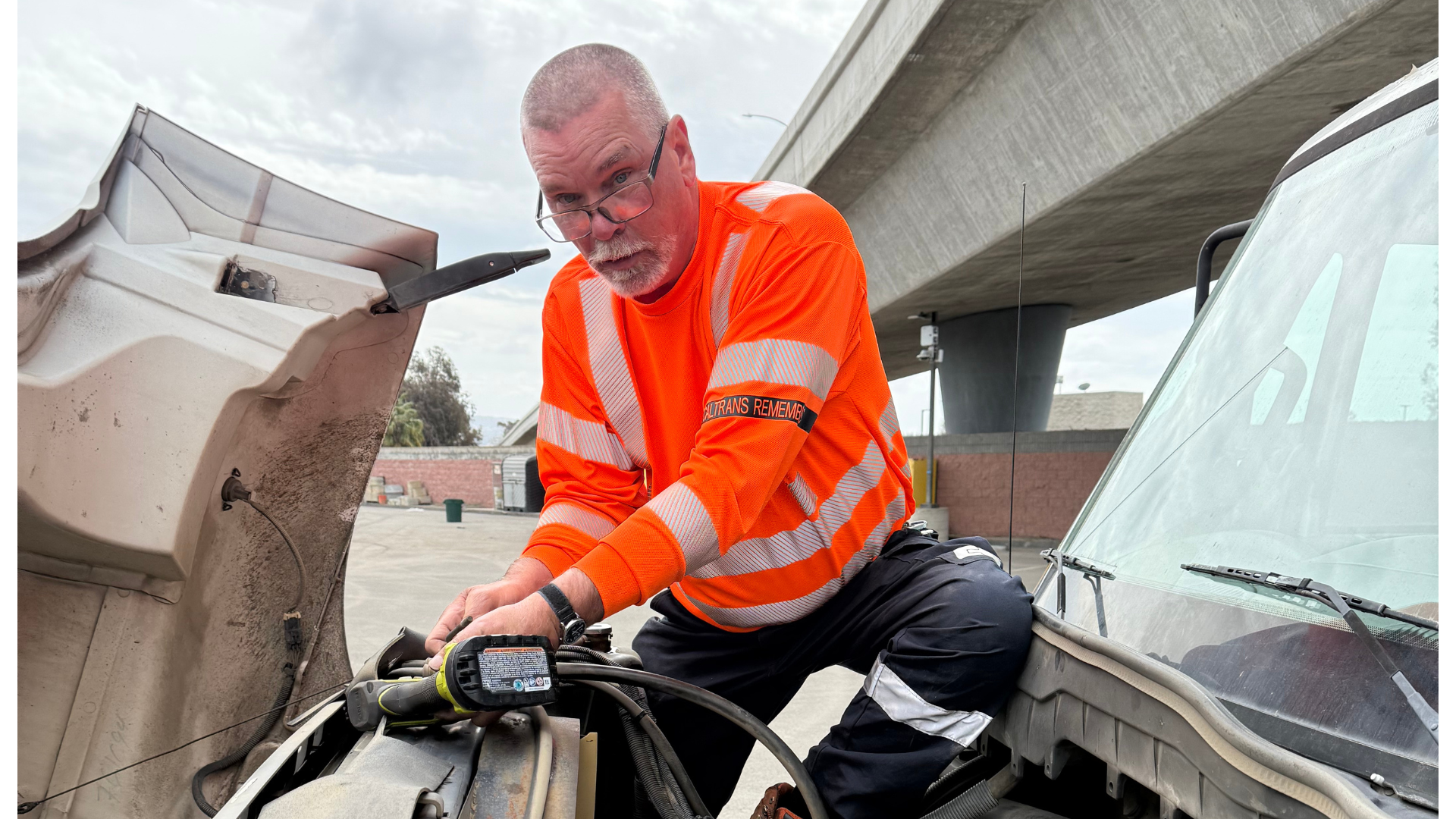
What’s in a name badge? For Philip, it’s the first ID he’s ever been proud of.
“I like to show off my State of California Caltrans ID card because, aside from a driver’s license, the only other ID card I had was either federal prison or state prison,” he says.
To understand why the card matters so much, you have to start with who he was long before he held it.
“I’m a worker,” he says. “Idle hands and idle minds get me in trouble, so I need to be working.”
Before his incarceration, he worked in home maintenance, fixing things with his hands and tools. Inside prison, he found similar work on machinery. Because he was a hard worker, he usually landed what he calls the “good jobs” and never had difficulty finding work.
Philip describes himself as dedicated, loyal and honest, even at his lowest points. Through three different prison terms, he maintained strong relationships with his girlfriend and family – a testament to the loyalty he says has always defined him.
But a record often speaks before the person does. After his release, Philip started his job search right away. Two companies said yes, and one even gave him a schedule. Then both offers disappeared after his background check.
“It was like a sock in the gut. It kind of let the air out of me—the momentum out of me,” he says. He had already told his family about the offer, and he felt he had let some of them down.
Then, at a Parole and Community Team (PACT) meeting, where organizations share what services they can offer to individuals coming home, he learned about Chrysalis. The organization’s employment social enterprise, which provides transitional jobs for people facing the greatest barriers to employment, caught his attention. The program would pay him to work while he searched for something permanent.
It was a relief. Clients can stay on a transitional job for only a year, but he thought, “At least I could slow down, catch my breath.”
This was the second chance other employers hadn’t been willing to give him.
“A lot of people have the motivation to prove themselves, but they don’t get the opportunity. And Chrysalis gave everybody the opportunity to prove who they are and not who they were.”
True to his lifelong work ethic, Philip made the most of it. On the Chrysalis Roads crew, where he worked in highway litter removal, Philip was promoted twice—first to lead and then to supervisor, which extended his yearlong term. The program’s flexibility gave him room to attend truck driving school and earn his commercial license along the way.
Working alongside people who had been in his shoes, including managers who were also justice-impacted, showed him what was possible.
“Sometimes it’s easier to identify with people that are succeeding that have gotten out of prison, and Chrysalis has those people there. When you see somebody who’s been down for 20 to 30 years and they’re doing well, that helps.”
Being part of Roads also put Philip in front of Caltrans leaders. Every morning, Philip’s crew reported to a Caltrans supervisor, who saw his work firsthand and encouraged him to apply: “Every day you’re here, it’s like you’re doing an interview,” the supervisor told him. By that measure, he could see that Philip would excel at Caltrans and even offered to be a reference for his application.
This time, his work was judged before his record was. It led Philip to where he is today: working full-time as an Equipment Operator with Caltrans, a permanent position he has held for nearly two years.
Looking back on the road that brought him here, he says he is the happiest he has ever been: “I am proud of myself. My family’s proud of me, as well, but I am happy with who I am and where my life is right now.”
His job still brings him into contact with Chrysalis, sometimes picking up workers who are early in their reentry journey. He likes being able to connect with them and hopes he can be an inspiration the way others were for him.
“It’s pretty fulfilling because one of the things I liked about Chrysalis was the way they’re helping the forgotten. Chrysalis specializes in [working with] people coming out of prison, people on probation, people that are homeless. The ones that the rest of the world has kind of forgotten about or maybe washed their hands to. Chrysalis is about giving second and third chances.”
With a meaningful career and loving family relationships, Philip now has the stability he’s been working toward for a long time. But nothing captures how far he’s come like his ID card.
“When I got my Caltrans ID, it was like, I belong to something,” he says. “The things I belonged to before were never worth bragging about. Belonging to Caltrans is something I can brag about. It’s not something I have to keep in the dark.”
The cards from his past never showed the whole person, and he knows it: “I like to think that I was still a good person, doing a lot of bad things…and my Caltrans ID, that’s the guy that’s finally gotten it right.”